| The American Plate Number Single Society | ||
|
HOME
MEMBERSHIP
PUBLICATIONS
LINKS
|
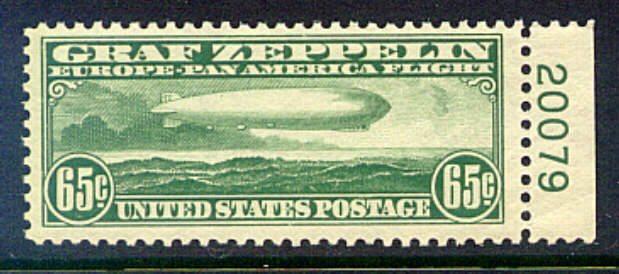 APNSS is organized to support stamp collectors interested in plate number singles and other marginal markings. A plate number is the serial number of a printing plate. It is printed in the selvage or border of a pane of postage stamps. From the early days of U.S. stamps, plate numbers generally appeared in the middle of the selvage. For example, plate number 20079 appears on the right selvage of the 65¢ Graf Zeppelin stamp shown above. Beginning with rotary press stamp printings in the 1930s, plate numbers were generally printed in the corner of each pane. Plate number 22206 appears in the selvage of the 50¢ Taft stamp from an upper left pane, shown below. Identical stamps from the upper right, lower left and lower right panes would make up a complete matched set of all positions for this issue.
From 1966-1981, the post office often printed a separate plate number for each color that was used in the printing process. Some collectors felt that this often required a large investment, as these issues were traditionally collected in plate blocks of 10, 12 or 20 stamps or even the entire pane. Plate number single collectors collect these issues in strips or as singles.
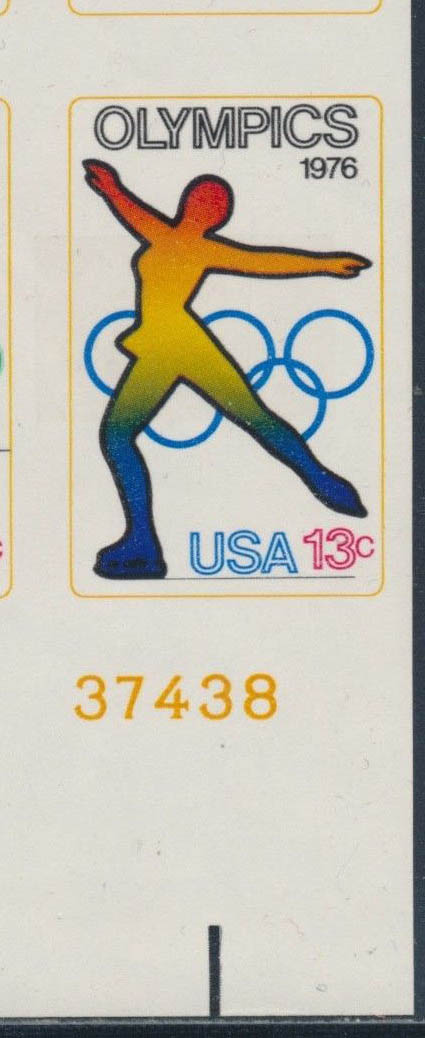
Scott 1698b, 13¢ Olympics error (no perforations), showing 5-digit yellow plate number. Additional plate numbers appear adjacent to other stamps, in magenta, cyan, black and each other color used to print the stamps. Beginning in 1981, the post office started reducing the now 5-digit plate number to a single digit for each issue, generally starting with 1. Multiple plates used to print multiple colors could now be represented by single digits in each ink color used, such as 1111.
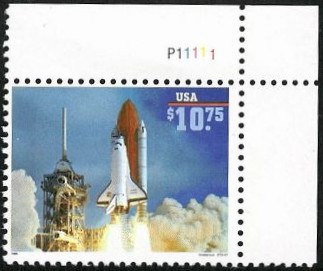
Scott 2544A, $10.75 Express Mail stamp, plate #P11111 showing a single digit for each color used in the printing process. Plate numbers also began to be printed on the face of coil stamps, introducing a whole new collecting interest. Previously, plate numbers were trimmed away from coil stamps as part of the printing and coiling process. (Some examples of partial plate numbers appearing on poorly-centered older coil stamps can be found on the Examples pages.)
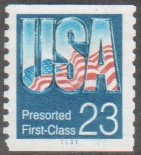
Scott 2607, 23¢ First Class Presort stamp, plate #1111 showing a single digit for each color used in the printing process. At the same time, printing contracts were opened up so that private security printers could bid on and print U.S. stamps. (Virtually all U.S. stamps from 1894 to the 1980s were printed by the Bureau of Engraving and Printing or BEP, a division of the U.S. Treasury Department.) A letter prefix was added to the plate number to designate the private firm. A, B, C, D, G, K, M, P, S, U and V have been used to date, as well as T on some BEP-printed test coils. X is also used on USPS sample images. In the 1990's, more and more U.S. stamps were issued in the self-adhesive format. The last true traditionally-gummed commemorative stamps were the 34¢ Enrico Fermi and James Madison issues of 2001. Although it is still possible to collect used coil plate number singles, where the plate number is printed on the face of one stamp in the coil at regular intervals, it is very difficult to collect used sheet and booklet self-adhesive stamps. To do so, the sender of a sheet stamp -- almost always a stamp collector -- would have had to carefully remove from the backing and place on the envelope not only the self-adhesive stamp itself, but also three bits of selvage, one of which includes the plate number that was printed in the margin. The recipient of either would need to save the used plate number single "on cover" or "on piece," as any attempt to soak the stamp off the envelope would permanently separate the stamp from the all-important selvage and plate number. Used plate number singles for modern self-adhesive stamps are almost always philatelically contrived. Modern self-adhesives are generally collected as mint examples, on their original backings as issued. Due to changes in paper manufacturing and USPS requirements, some issues are notoriously difficult to soak off of their backing paper. In fact, many are downright impossible, as they were manufactured without the water-soluble layer of glue that allows this to happen. Many collectors save modern issues on neatly-trimmed single-layer backing paper. In 2010, USPS announced they would no longer increment plate numbers for additional printings of a stamp, unless there was a significant change in the technology or design. This is the USPS's definition, not stamp collectors' definition. Since that announcement, most stamps have been issued with plate numbers of "all ones," and the issuance of additional plate numbers with "all twos" is unusual and unannounced. At the same time, all other marginal markings were moved to the back of the self-adhesive pane. The American Plate Number Single Society was formally organized in 1976, although it traces its beginnings to 1952. APNSS originally got its start as an organization for collectors of postally used plate number singles. APNSS joined the APS as Affiliate #178 in 1988. 39% of our members collect mint (or unused) plate number singles, 27% prefer used PNS, and the remaining 34% collect both mint and used. Stated another way, 73% of our membership collect mint PNS, and 61% collect used PNS. Some APNSS members also collect other marginal markings, such as singles with ZIP, copyright, and pane position markings, logos, siderographers' or plate finishers' initials, TOP markings, denomination aids and other markings. Click here for a glossary of plate number-related stamp terms.
Comments? Suggestions? Email the Webmaster: This page last updated June 1, 2023.
Opinions expressed by authors are their own and do not necessarily reflect those of the APNSS, its officers or members. |
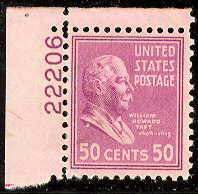 Scott
831,
plate number single 22206
Scott
831,
plate number single 22206